WHT
Classic white
Heritage cottage spec. Painted or vinyl-clad.
Fences · decorative
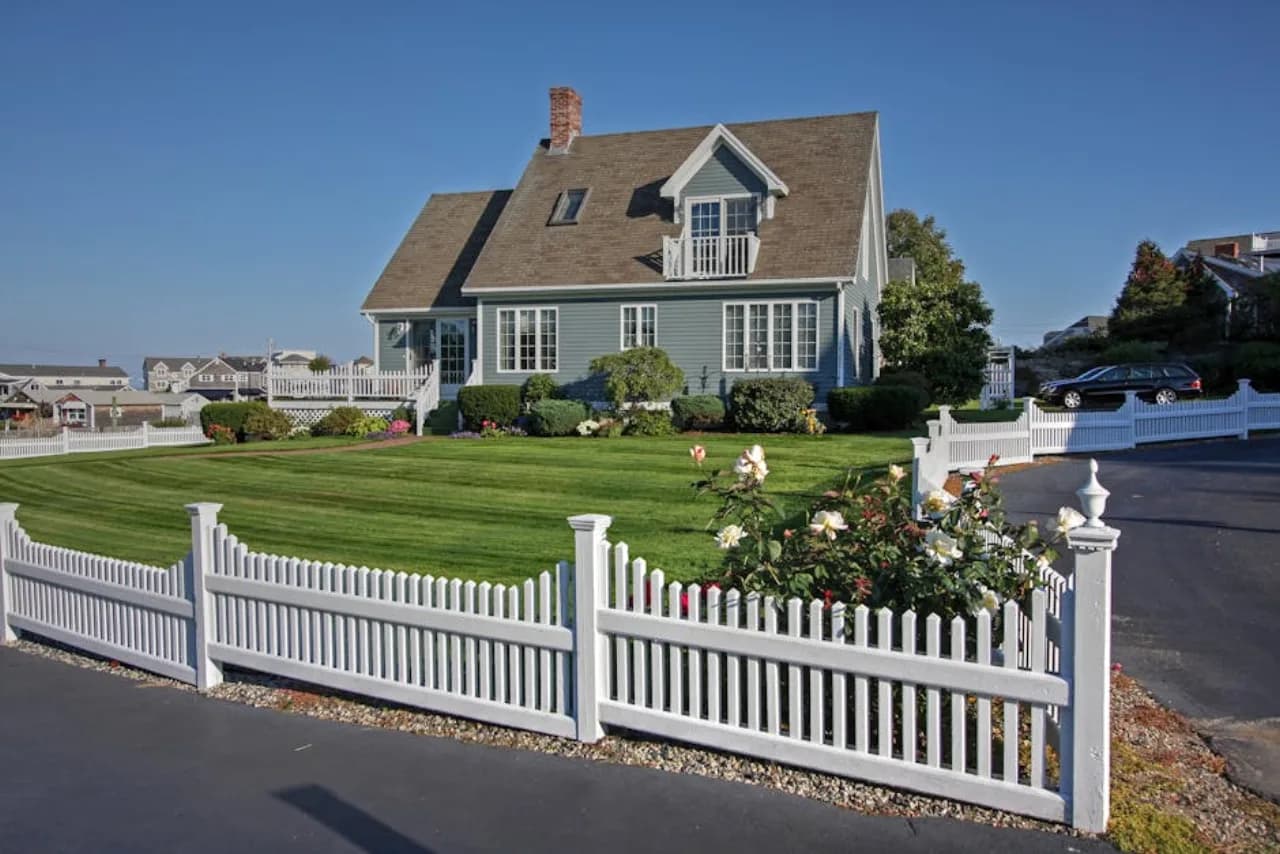
Classic 3' and 4' picket in wood, vinyl, aluminum. Gothic, French Gothic, dog-ear, flat-top profiles. White, natural, custom colour.
The picket fence is heritage Canadiana. The 3′ or 4′ white-picket front-yard fence with the painted gate and the formal scalloped top-rail evokes Maritime cottage, Ontario heritage, and Quebec village aesthetics simultaneously. Fenced.ca stocks picket in wood (cedar or PT pine), vinyl (white, almond, grey), and aluminum (black, bronze, white). Profiles run from utilitarian flat-top through dog-ear (45° cut corners), gothic point, French gothic with rounded base, and decorative pyramid finials.
Engineering: picket is structurally undemanding — the open mesh of vertical pickets doesn't catch wind the way solid privacy does. 4×4 posts at 6′–8′ centres for wood, vinyl-sleeve-over-wood-core at 8′ for vinyl, factory-routed posts at 8′ for aluminum. Posts to frost depth.
Municipal compliance: most Canadian cities cap front-yard fence height at 1.2 m / 4′ to preserve corner-lot daylight triangles and pedestrian sightlines. Picket fits this perfectly. Heritage districts often have specific picket profile and colour requirements — Westmount, Old Town Toronto, Victoria's Beacon Hill, Old Quebec all maintain heritage guidelines. Our heritage-replica picket profiles are pre-approved in several heritage districts; ask the design team.
Picket styles: Classic 1×4 pointed (suburban front yards), Cape Cod scalloped (heritage), dog-ear (utility), and square-top (modern). Pickets typically 80–95 mm wide with 40–50 mm gaps for the open-airy look.
Material choice: PT pine is the price leader. Cedar for premium look + natural rot resistance. Vinyl for zero-maintenance. Composite for marine-grade applications. Painted white vinyl pickets dominate east-coast and Ontario heritage neighbourhoods.
Heights: 0.9 m (3 ft) for front-yard decorative — does not require permits in most Canadian municipalities. 1.2 m (4 ft) for child-safe boundary. Heights above 1.5 m typically need a building permit and may trigger setback rules from property line.
Pricing & lead time: Picket fence pricing: PT pine 3-foot runs $20–35 LF installed, cedar pointed 3-foot at $30–50 LF, vinyl white picket at $35–55 LF, composite picket at $50–80 LF. Painted/stained finish adds $5–10 LF. Lead time 5–10 business days for stock; custom heights add 1 week. Permit-exempt in most provinces at heights ≤0.9 m.
How picket fence stacks up against the alternatives — at a residential height of six feet, in median Canadian markets.
Stake the line, check setback rules with the municipality, locate utilities (Info-Excavation in QC, Ontario One Call elsewhere).
End, corner, and gate posts. Concrete footings to frost depth — 1.2m in most of the country, 1.8m in northern Alberta and the territories.
Spaced 10' on centre. Plumb each one before the concrete sets.
1⅝” galvanized pipe, slipped through line-post loop caps.
Tension along the top rail with a come-along, hog-ring to the rail every 24”. Tie wire every line post.
Bottom tension wire, gate hinges, latch hardware. Cap exposed wire ends.
Salt-air corrosion: spec galvanized-after-weave or vinyl coat. Frost line 1.2m.
Permis obligatoire in most municipalities. Bilingual quote PDFs standard.
OBC §9.10 for pool perimeters. Conservation Authority rules along the moraine.
Frost line 1.4–1.5m. Wind-rated panels for the shelterbelt swap-outs.
Coastal: vinyl coat. North: 1.8m frost, schedule-40 pipe for snow load.
White picket fence is still a recognized residential look in Canada, but the dominant 2026 trend is matte black aluminum or vinyl picket and natural cedar — see the colour question for context. White picket still works on: heritage homes (Victorian, Cape Cod, Farmhouse styles), front yards where the house is in a contrasting dark colour, and beach / cottage builds. White picket reads dated on: contemporary builds (the architectural shorthand is wrong), homes with bold exterior colour where white competes, and suburbs where every house has one. Material matters: white vinyl picket holds white for 15+ years with no maintenance, white-painted wood needs repainting every 4-7 years and discolours from road salt and tree sap. If you want the white-picket aesthetic with longevity, spec vinyl with a UV-stabilized white pigment, not painted wood.
DIY-cutting your own pickets from raw cedar 1×4 lumber is cheaper than buying preassembled picket panels — typically 25-40% less in materials. For 100 linear feet of 4-ft picket fence: raw cedar lumber for pickets plus 2×4 rails runs $400-700, preassembled panels run $700-1,200. But DIY adds labour: you'll spend 8-15 hours cutting picket tops, drilling pilot holes, and assembling against a stretched string. Where DIY wins: long runs (the per-foot savings scale), specific historic profiles, and projects where the post setting is the same labour either way. Where preassembled wins: gates and corners where alignment matters, time-constrained installs, and any case where you'd otherwise hire a contractor (their margin on panels is lower than their margin on cutting). Vinyl picket is always preassembled — DIY cutting isn't an option.
A picket fence is a fence made of vertical boards ("pickets") attached to horizontal rails, with visible gaps between the pickets. The pickets are typically 3 to 4 inches wide, spaced 2 to 3 inches apart, and 3 to 4 feet tall. The horizontal rails run top and bottom (sometimes a middle rail on taller fences). Picket tops can be flat, dog-eared, gothic (peaked), French gothic, or scalloped — the profile is most of the aesthetic. Historically the picket fence was a low-cost residential boundary fence in 18th and 19th century North America; the white-painted wood picket became a cultural shorthand for the idealized suburban home. Modern picket fences are sold in wood (cedar, pine, pressure-treated), vinyl (PVC), aluminum, and steel — same silhouette, different materials. It's a visual / decorative fence, not a privacy or security fence.
The name comes from the French piquet, meaning "pointed stake" or "sharpened post," originally referring to wooden stakes driven into the ground for military encampments — pointed at the top so they could be planted spike-up as a low defensive barrier. By the 1700s the term had migrated to North America and shifted to describe any pointed vertical board in a residential fence. The pointed (gothic) top on traditional pickets is the etymological link to the original meaning, though most modern pickets use flat or dog-ear tops for cost and safety. In French, the same word survives as piquet de clôture — and the structure is la clôture à piquets. Fenced.ca uses "picket" in English and "piquet" in French for product names; both reference the same vertical-board-with-rail construction whether the top is pointed or flat.
Modern alternatives to the traditional picket fence that keep the boundary-defining role: 1) Horizontal slat fence — 1×4 or 1×6 boards run horizontal instead of vertical, contemporary look, $35-65 per foot supply in cedar or thermally modified ash. 2) Aluminum picket in matte black or bronze — same silhouette as wood picket, low maintenance, $35-70/ft. 3) Steel cable rail on cedar or steel posts — minimal visual weight, $40-90/ft, common on lakeside and ravine lots. 4) Cor-Ten weathering steel panel — solid sheet, rust-patina finish, architectural, $80-150/ft. 5) Black chain-link with privacy slats — utilitarian budget version of the modern look at $20-40/ft. 6) Hedge as boundary (no fence) — cedar, yew, or hornbeam. Each trades cost, maintenance, screening, and style. For a heritage home, traditional picket still reads correct.
"White picket fence mentality" is an English-language cultural idiom referring to the idealized vision of post-war suburban domestic life — single-family home, two-car garage, lawn, white picket fence, nuclear family — that became the aspirational template in 1950s North America. The phrase is used both nostalgically (positive association with stability and ownership) and critically (limiting, exclusionary, or naive view of a homogenized ideal). It's not a property concept and isn't relevant to actual fence-buying decisions, but it shows up in real-estate copy and lifestyle writing. From a practical fencing standpoint we just note that the actual white picket fence remains a viable residential boundary fence in 2026, with vinyl now the dominant material because painted wood requires constant upkeep. See our white-picket and picket-meaning questions for the practical details.
Ready to spec it?