Atlantic
Salt-air corrosion: spec galvanized-after-weave or vinyl coat. Frost line 1.2m.
Fences · pool
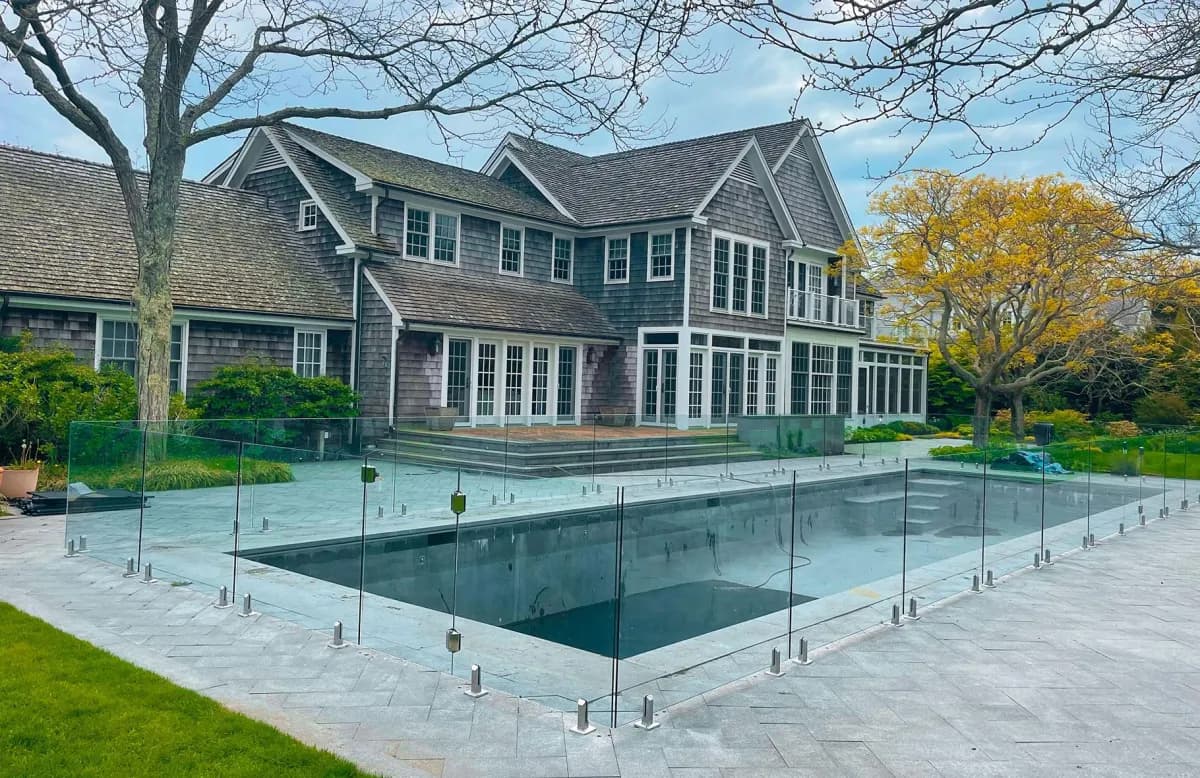
Frameless glass, semi-frameless glass, and aluminum pool fences. Code-compliant for every Canadian province. Self-closing self-latching gates. 4' minimum height.
The pool fence is the regulated fence. Every Canadian province with significant residential pool ownership has a building-code or municipal-bylaw pool-enclosure requirement, and the most stringent — Quebec's 2025 update — is the spec we engineer to as a default. Fenced.ca's pool-fence range covers three substrate categories: frameless glass (12 mm tempered safety glass in glass-clamp post mounting; the maximum aesthetic clarity, premium price point), semi-frameless glass (12 mm tempered glass in aluminum top and bottom rails; lower cost than frameless, more conventional appearance), and aluminum pool-code (vertical-picket aluminum with 4″ max picket spacing; the cost-effective workhorse).
QC Règlement piscine 2025 spec: enclosure 1.2 m minimum height; no climbable surface (chair, planter, AC condenser, equipment) within 1 m of the enclosure exterior; gate must be self-closing AND self-latching with latch mechanism either ≥1.5 m above grade or installed on the pool-side face inaccessible from the outside; vertical gaps between pickets ≤10 cm; no horizontal members on the exterior face that could serve as foothold. Applies to in-ground pools and all above-ground pools 60 cm deep or more, including inflatable.
All our pool-fence assemblies ship with documentation referencing the applicable provincial regulation for inspector handoff — the gate hardware, picket spacing, and post engineering all carry shop-drawing references.
Pool code compliance: Every Canadian province with significant residential pool inventory has pool-enclosure legislation requiring barriers around pools deeper than 600 mm. Quebec's Loi 322 and RBQ B-1.1 are the strictest: 1.2 m minimum height, no horizontal climbable rails within 1.2 m of grade, self-closing self-latching gates at 1.5 m latch height, and maximum 100 mm gap between vertical members. Ontario's OBC 9.10 and BC's Pool Safety Bylaw mirror this with minor variances.
Glass specifications: 12 mm tempered safety glass is the industry standard for residential pool enclosures. 15 mm tempered laminated for commercial. Glass-only (frameless) uses stainless steel spigots mounted to concrete or paver bases. Glass + aluminum hybrid posts give structural rigidity with sightline transparency.
Aluminum picket alternative: Code-compliant aluminum pool fence (black powder-coated, 100 mm picket spacing, 1.2 m height) is the budget option at $40–60 per linear foot installed vs $120–180 for frameless glass. Both meet code; glass is the premium aesthetic choice.
Pricing & lead time: Pool fence installed pricing: frameless glass (12 mm tempered) runs $120–180 LF, glass + aluminum hybrid at $80–130 LF, code-compliant black aluminum picket at $50–85 LF. Self-closing self-latching gates add $300–600 each. 6–8 week lead time for tempered glass (must be factory-cut). Aluminum picket ships in 2–4 weeks. Provincial code compliance verified at quote stage.
How pool fence (glass + aluminum) stacks up against the alternatives — at a residential height of six feet, in median Canadian markets.
Stake the line, check setback rules with the municipality, locate utilities (Info-Excavation in QC, Ontario One Call elsewhere).
End, corner, and gate posts. Concrete footings to frost depth — 1.2m in most of the country, 1.8m in northern Alberta and the territories.
Spaced 10' on centre. Plumb each one before the concrete sets.
1⅝” galvanized pipe, slipped through line-post loop caps.
Tension along the top rail with a come-along, hog-ring to the rail every 24”. Tie wire every line post.
Bottom tension wire, gate hinges, latch hardware. Cap exposed wire ends.
Salt-air corrosion: spec galvanized-after-weave or vinyl coat. Frost line 1.2m.
Permis obligatoire in most municipalities. Bilingual quote PDFs standard.
OBC §9.10 for pool perimeters. Conservation Authority rules along the moraine.
Frost line 1.4–1.5m. Wind-rated panels for the shelterbelt swap-outs.
Coastal: vinyl coat. North: 1.8m frost, schedule-40 pipe for snow load.
Quebec's Pool Safety Regulation, updated in 2025 (Règlement sur la sécurité des piscines résidentielles), requires that every residential pool — in-ground, above-ground over 60 cm, or semi-inground — be enclosed by a barrier at least 1.2 metres (4 feet) high. The barrier must have no horizontal members or gaps that allow climbing or that exceed 10 cm wide between vertical pickets. Gates must be self-closing and self-latching, with the latch on the pool-side at minimum 1.5 m above ground. The 2025 update extended the regulation retroactively — pools installed before 2010 must now also comply. Glass pool fence with aluminum posts, aluminum picket, and PVC are all compliant systems we supply for Quebec. The municipality issues the permit and does the inspection; fines for non-compliance start at $500 per day.
Pool fence cost in Canada in 2026 ranges $30 to $150 per linear foot installed depending on material and code requirements. For a typical residential pool with 120-180 ft of perimeter you're looking at $4,000-25,000 turnkey. Aluminum picket (the most common pool fence) runs $40-80 per linear foot installed. Glass pool fence with aluminum or stainless posts runs $90-180 per foot installed — the premium look. Vinyl picket runs $35-60. Wood is allowable in some provinces but uncommon for pools because of moisture and chlorine exposure. Mandatory features that affect price: self-closing self-latching gates ($400-1,200 each), 4-inch maximum gap between pickets, no horizontal climbable members under 4 feet, and 1.2 m (Quebec, Ontario) or 1.5 m (BC, depending on municipality) minimum height. Permit and inspection are separate municipal costs typically $150-400.
Yes — every Canadian province with significant residential pool inventory has pool-enclosure legislation requiring a barrier around residential pools. Ontario: Pool Enclosure Act / municipal pool-fence bylaws (Toronto, Ottawa, Mississauga, etc.) — 1.2 m minimum, self-closing self-latching gates, ≤10 cm picket gaps, no climbable horizontals. Quebec: Règlement sur la sécurité des piscines résidentielles (updated 2025) — 1.2 m minimum, retroactive to all pools including pre-2010. BC: Building Code Part 9 references plus municipal bylaws — 1.5 m typical, varies by municipality. Alberta and the Prairies: most large municipalities (Calgary, Edmonton, Winnipeg) require enclosures at 1.5 m. Atlantic provinces follow building-code-plus-bylaw pattern similar to BC. Above-ground pools over 60 cm wall height are typically treated the same as in-ground. Hot tubs with locking lockable covers may be exempt. Always check your municipality.
Cheapest code-compliant pool fence: black powder-coated aluminum picket at 1.2 m height, $35-50 per linear foot supply, $40-65 installed. Aluminum is the volume product for pool fence in Canada because it meets every code requirement out of the box (gap spacing, no horizontal climbables, self-closing gate compatibility, corrosion resistance) without the price tag of glass. Vinyl picket can be cheaper supply-only but adds cost in gate hardware and longevity in chlorinated humid air. Chain-link is the absolute cheapest material but does NOT meet pool code in most Canadian municipalities because the mesh diamonds are climbable. Skip wood: it works in the regulation but the chlorine + UV + freeze cycle eats it in 8-10 years. Self-closing self-latching gates add $400-900 each above the per-foot rate; budget for at least one gate per pool, sometimes two.
Ontario pool fence rules in 2026 are set by the provincial Pool Enclosure Act framework and your municipal bylaw (Toronto, Mississauga, Ottawa, Hamilton each have specifics). Core requirements: minimum 1.2 m height above ground on the outside; no horizontal members between 100 mm and 900 mm above grade (so people can't climb the fence as a ladder); pickets or mesh openings ≤100 mm wide; bottom gap to grade ≤100 mm; gates self-closing and self-latching with the latch on the pool-side at minimum 1.5 m above grade; gates open outward (away from pool); permit and final inspection by the municipality before the pool can be filled. Chain-link is generally not accepted because the diamond mesh is climbable; if used at all the diamonds must be filled with slats or the inside face boarded. Houses can serve as one side of the enclosure if all doors leading to the pool area are self-closing with audible alarms.
Average pool fence cost in Canada in 2026 for a typical residential 150-foot perimeter: $7,500-15,000 turnkey for aluminum picket, $13,000-27,000 for glass with aluminum or stainless posts, $5,500-9,000 for vinyl picket. Average per linear foot installed: aluminum $50-100, glass $90-180, vinyl $35-60. Self-closing self-latching gates add $400-1,200 each. Permit and inspection: $150-400 depending on municipality. Two factors push above-average: pool decks at multiple grade levels (need stepped fence sections, more gates), and architectural-spec finishes (powder-coat colour matching, frameless glass panels with stainless point fittings). Two factors push below-average: standard pool shape with single gate access, standard black aluminum picket, and combining with new pool install (the contractor can roll the fence into the package).
Ready to spec it?