Atlantic
Salt-air corrosion: spec galvanized-after-weave or vinyl coat. Frost line 1.2m.
Fences · site-services
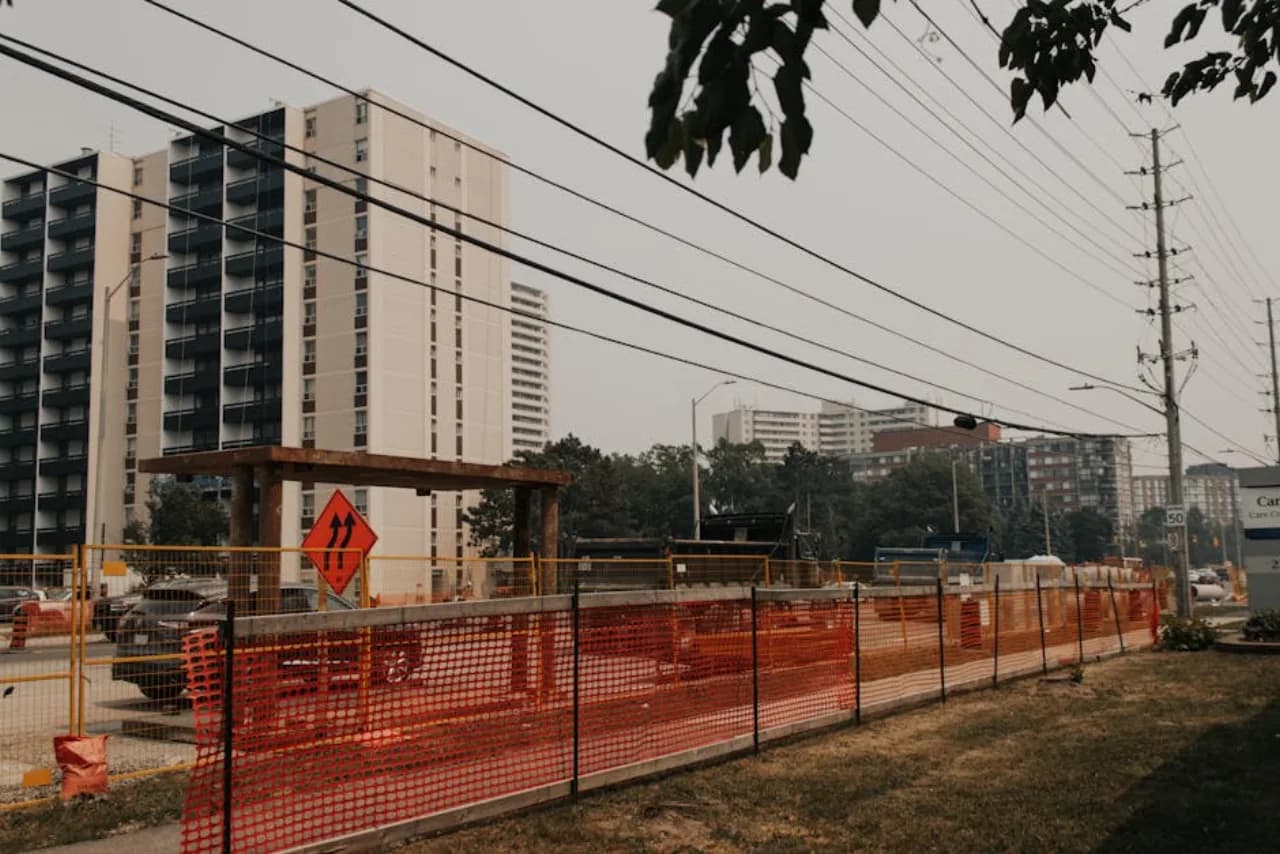
Geotextile silt fence for erosion and sediment control on construction sites. 36" standard height, wire-backed heavy-duty. SWPPP / ECP compliance.
Silt fence is the construction-site compliance product. Provincial and municipal stormwater regulations (SWPPP in the US tradition, ECP — Erosion and Sediment Control Plan — in Canadian municipal practice) require sediment-laden runoff from construction sites be filtered before reaching downstream watercourses. Silt fence is the line-of-defense: a permeable geotextile barrier on T-posts that slows runoff, settles sediment, and allows clean water to pass through.
Fenced.ca supplies standard silt fence (geotextile fabric, 36″ height, on plastic stakes or T-posts; the residential and small-commercial standard), wire-backed heavy-duty (woven geotextile on welded-wire mesh backing on T-posts; suited to multi-month installations, slope sites, and higher-flow conditions), and inlet protection (catch-basin geotextile barriers — silt-saver, silt-sock, gravel inlet kits — for the storm-drain inlets within or adjacent to the construction site).
Roll size: 100′ standard rolls in standard and wire-backed; 50′ rolls available for small-job installations. Installation is straightforward (post, attach, trench-and-bury the bottom 6″) and most contractors self-install; our crews can install for large-site or multi-phase projects where installation efficiency matters.
Erosion-control specification: Woven geotextile fabric rated CCDC erosion class B or A for construction sites. Standard residential height 600 mm above grade with 150 mm buried trench. Heavier-grade silt fence (class A) for 1.0 m height on slopes >15% or near sensitive watercourses.
Regulatory: Required by most Canadian municipalities on construction sites >150 m² disturbance. OCETA (Ontario), MELCCFP (Quebec), and MOECC site-control standards. Inspections weekly during construction; replace torn or undermined sections within 48 hours.
Installation: Trench bottom 150 mm into virgin soil, anchor fabric in trench, backfill and compact. Posts on 1.8 m centres (2 m max). Top of fabric 600–900 mm above grade. Effective for 1–3 construction seasons before fabric UV-degrades.
Pricing & lead time: Silt fence pricing: standard 600 mm class B woven runs $3–6 LF installed, heavy 1.0 m class A at $6–10 LF, wire-reinforced for high-erosion sites at $10–18 LF. 48-hour delivery to construction sites in major Canadian metros. Installation crews available for 600 m+ runs.
How silt fence stacks up against the alternatives — at a residential height of six feet, in median Canadian markets.
Stake the line, check setback rules with the municipality, locate utilities (Info-Excavation in QC, Ontario One Call elsewhere).
End, corner, and gate posts. Concrete footings to frost depth — 1.2m in most of the country, 1.8m in northern Alberta and the territories.
Spaced 10' on centre. Plumb each one before the concrete sets.
1⅝” galvanized pipe, slipped through line-post loop caps.
Tension along the top rail with a come-along, hog-ring to the rail every 24”. Tie wire every line post.
Bottom tension wire, gate hinges, latch hardware. Cap exposed wire ends.
Salt-air corrosion: spec galvanized-after-weave or vinyl coat. Frost line 1.2m.
Permis obligatoire in most municipalities. Bilingual quote PDFs standard.
OBC §9.10 for pool perimeters. Conservation Authority rules along the moraine.
Frost line 1.4–1.5m. Wind-rated panels for the shelterbelt swap-outs.
Coastal: vinyl coat. North: 1.8m frost, schedule-40 pipe for snow load.
A silt fence is a temporary sediment-control barrier — geotextile fabric stretched between driven wooden or steel stakes — that filters runoff water during construction. The fabric is permeable to water but blocks suspended soil particles, so stormwater flowing across a disturbed site passes through the fabric while sediment accumulates on the upslope side. Standard residential silt fence is 36-inch black or grey polypropylene woven geotextile on 2x2 wood stakes at 6-ft spacing; commercial/highway specifications use heavier 48-inch fabric on steel T-posts with wire backing. Critical install details: bottom 6 inches buried in a J-trench upslope to prevent undermining, fabric stapled or wired to the upslope face of stakes (so water pressure pushes fabric into the stake, not pulls it off), and entrenched along contour lines, not straight downhill. Silt fence works for sheet flow on slopes under 5% — concentrated flow rips it out.
Use a silt fence whenever a construction site disturbs soil within sheet-flow distance of a drainage feature: storm sewer inlets, ditches, streams, lakes, wetlands, or a neighbouring downhill property. Most Canadian municipal bylaws and Ontario / Quebec / BC environmental regulations require silt-fence on any site over a threshold disturbed area (commonly 1,000 to 5,000 sq m), and on any site discharging to a Schedule 1 / Schedule 2 watercourse regardless of size. Install along the downslope perimeter of the disturbed area, following contour lines. Don't use silt fence for: concentrated flow paths (use straw wattles, rock check dams, or sediment basins), slopes over 10% (sheet flow can't be assumed), or in lieu of inlet protection at storm drains (use bag-style inlet protection). Maintain by removing accumulated sediment when it reaches 1/3 the height of the fabric.
Yes — a properly installed silt fence is designed for water to pass through the woven geotextile while sediment is retained. Flow rate through standard residential silt fence fabric is typically 10-25 gallons per minute per square foot when clean, dropping as sediment cakes the upslope face. That's why silt fence works: it slows runoff enough to drop the sediment without ponding water permanently against the fabric. If water builds up significantly behind the fence, it means: 1) sediment has caked the fabric and it needs maintenance (scrape or replace), 2) flow concentration exceeded sheet-flow capacity (you need a different BMP), or 3) the fabric was hung without trench burial so water is finding the bottom. Heavy-duty fabrics rated for higher flow exist (woven monofilament vs. nonwoven, different aperture sizes). Silt fence is not a dam — if you need ponding for settlement, use a sediment trap or basin.
Yes — Fenced.ca operates as a Canada-wide multi-category fence supplier, with our Canada-wide network in Toronto, Montreal, Calgary, and Vancouver. We ship every fence category we carry — chain-link, wood, vinyl, aluminum, wrought-iron, steel, privacy, picket, split-rail, glass pool, temporary, security, farm, dog, electric, garden, gabion, snow, silt, and driveway gates — to all 10 provinces. The three Territories are quote-on-request because freight is the dominant cost line; we will quote Whitehorse, Yellowknife, and Iqaluit, but a flatbed lane has to be confirmed first. We do not ship internationally. Installation is offered nationally through our vetted installer network where coverage exists, and supply-only for everything else.
Supply means we ship materials — panels, posts, hardware, gates — to your jobsite or yard, and you (or your contractor) install. This is our primary business and covers all 20 fence categories nationally. Rental is offered for temporary fence (construction site fence, event fence, crowd-control barrier), silt fence, and snow fence — categories where the fence comes down after a defined project window. Rental includes delivery, pick-up, and weekly billing; minimum rental is typically one week, with multi-month and multi-site rates available. Installation is offered through our regional installer network in major metros (GTA, Montreal, Calgary, Vancouver, Ottawa, Edmonton) and quoted per-project elsewhere. You can mix and match: supply only, rental only, or supply + install as a turnkey package.
Fence pricing in Canada in 2026 ranges from roughly $15 per linear foot for basic chain-link to $120+ per linear foot for high-end aluminum or wrought-iron with custom gates. Mid-range materials — pressure-treated wood, vinyl, standard aluminum — typically run $30 to $70 per linear foot installed. The biggest cost drivers after material are: post depth (a 4-foot frost line vs. an 8-foot Prairie frost line changes the post count and concrete volume), gate count, terrain (slope, rock, root cuts), and labour market — the GTA, Vancouver, and Calgary command higher install rates than smaller centres. Supply-only costs (no labour) typically run 40-60% of the turnkey figure. We provide itemized quotes that separate materials, hardware, freight, gates, and installation so you can see exactly what scales with project size.
Ready to spec it?